

 Català
 Español
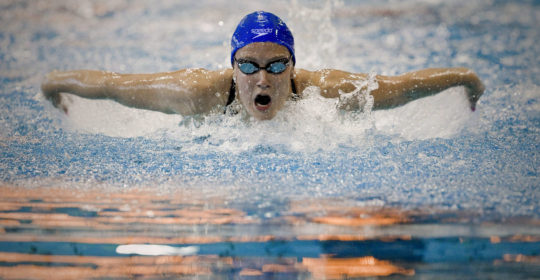
Most common injuries in swimming
Swimming is a sport in which there are minimal trauma through physical contact as a result of the development of the activity. However, there are injuries of different nature: the most common are due to “overuse syndrome” that occur when a gesture is repeated many times over time. The swimmer makes the same gesture in every workout and for many years. To go 25 meters, a swimmer needs to give 15 strokes (8 cycles) approximately each arm and at an elite level or high performance, training daily volume between 7 and 10 km. Therefore the gesture more than 6,000 times every day repeat training (6 days a week for a season of 16 to 20 weeks). This will inevitably lead to overuse in joints where usually the hardest hit is the shoulder.
Specifically swimmers, serious injuries are rare, compared to other sports. However, shoulder injuries are quite common and may even limit the development of his career.
With these data, it is easy to understand that in competitive swimming shoulder pain is the most common problem, followed by problems in the cervical spine, neck muscles and thoracolumbar spine, and finally knees, hips and ankles, depending on style overcoat in which nothing and technical potential injuries. The gesture more features are:
- Epicondylitis elbow in “butterfly”.
- Lumbar pathology (spondylosis) in “Butterfly” and “breaststroke”.
- Shoulder subluxation “back”.
- Patellofemoral pain (knee) on “breaststroke”.
- Tenosynovitis of the extensor of the foot, “crol” and “back”.
- Painful shoulder syndrome “crol” and “butterfly”
A lesion syndrome “painful shoulder” it is also known as “swimmer’s shoulder” and within this designation include a series of injuries, such as acromioclavicular arthritis, multidirectional glenohumeral instability and pathology understanding sleeve rotator, which is the most frequent and important in swimming.
The incidence of shoulder pain in swimmers racing has recently been estimated at 38% while the prevalence has been between 10% and 35%. Between 50 and 60% of injuries are swimmer’s shoulder.
Impingement syndrome occurs when the supraspinatus tendon is committed to its sliding under the acromion and the coracoacromial arc. This syndrome can be a primary when the tendon itself or acromial osteophyte which engages the sliding or conversely, secondary or functional when the scapulae is destabilized by an anteroinferior position.
In synchronized swimming injuries also occur by repetition of gestures, especially in overtraining, poor heating or cooling, children’s ages, poor technical execution … Here they appear in addition to the tendinitis other pathologies such as periostitis (inflammation of the capsule that surrounds the bones) or entesitis traction (pain in the tendon insertion into bone), the more immature skeletons own last growing.
Before finishing remember that the swimmer back pain may be due to a wrong turn on the wall (or turn) when there is a weak abdominal wall musculature.
Top 10 tips to avoid injuries in swimming are:
1. Consult with professionals before the onset of discomfort (not expected to be too evolved),
2. Alternate various styles in swimming,
3. Alternate swimming with other sports,
4. Distribute workloads (progressive adaptation throughout the season),
5. Consult professionals if there are contraindications to the practice of specific styles,
6. If you have a regular sport personal trainer,
7. Giving periods rest to recover (planned throughout a season),
8. Perform core strengthening and cross training exercises as part of the routines at the beginning and during the season,
9. Heating and cooling (stretching) out of the water as usual pattern in each workout,
10. Work the correct technique throughout all the season (it is one of the essential pillars to avoid injury).
We finish up with a number in line with these dates. Being Olympic is reserved for a few, but necessarily involves exceed 10,000 hours of personal training.
Leave a reply →